AI Training + Online Safety for Staff and Parents
Practical, up-to-date sessions that help educators and parents to understand the latest AI and online risks, and know how to respond.
AI + Online Safety for Staff and Parents
AI and online platforms are changing incredibly quickly.
New tools, risks and behaviours are appearing faster than most teachers or parents can reasonably keep up with. One month it is AI companions. The next it is deepfakes, smart glasses, AI influencers or another platform students are using before most adults have heard of it.
At the same time, schools are being asked to work out how AI should be used in teaching and learning, what appropriate use looks like, and how to protect the learning that matters.
Teachers and parents do not need to know everything about every new platform. They do need enough understanding to know what matters, what to look out for and how to respond.
These sessions give the adults around young people practical, current information to do exactly that.
Online Safety Briefing:
Emerging Digital Risks for Schools
Best for:
Teaching, pastoral care, wellbeing and leadership staff
What this session covers:
It is nearly impossible for school staff to keep up with every platform, trend and online risk students are encountering.
And yet these issues increasingly end up at school.
AI companions. Deepfake images. Gaming platforms. AI-generated content. Smart glasses. New social media behaviours. New ways students are getting around restrictions.
This Online Safety Briefing gives staff a practical update on what is changing in young people's digital lives and what schools need to know now.
Paris draws on her work with thousands of students each year and consultations with young people to unpack the trends she is seeing in real time.
-
The latest online safety topics including:
AI chatbots, companions and emotional reliance
Deepfakes and AI-generated intimate images
AI influencers and fake online content
Smart glasses and wearable recording devices
Gaming platforms and social risks
New social media behaviours and trends
Misinformation and AI-generated content
New online harms and platforms schools should know about
-
Staff will leave with:
A clearer understanding of current online risks
Insight into how young people are using emerging technologies
Practical strategies for responding when issues arise
Language for conversations about AI, privacy, consent and online behaviour
Ideas for where schools may need proactive education
Keeping Kids Safe in the Age of AI
Parent Workshop
What this session covers:
Children's online lives are changing faster than most parents can realistically keep up with.
AI is now built into search engines, games, social media, chatbots and the content children watch. Parents are also navigating deepfakes, AI-generated content, privacy risks and entirely new types of online relationships.
And much of this is happening outside school, on phones, at home and on platforms parents may never have used themselves.
-
Parents will:
Understand where children are already encountering AI
Learn about AI chatbots and companions
Understand deepfakes and AI-generated image abuse
Learn what children should and should not share with AI tools
Understand how AI-generated content affects trust online
Learn about emerging platforms and behaviours
Get practical strategies for conversations about privacy, safety, consent and responsible technology use
Take home resources and conversation starters
-
Parents will also walk away with a Digital Parenting Toolkit packed with practical conversation starters, family activities, templates and useful resources to help them put what they have learned into practice at home and continue the conversation with their children after the session.
Keeping Kids Safe in the Age of AI helps parents understand what is changing, what actually matters and how to support their children without trying to monitor every click.
Practical AI Foundations for Teachers
Best for:
Teaching staff and school leaders who want to learn about how to use AI tools, including Copilot Teach, effectively.
What this session covers:
There is a big difference between hearing that AI can save teachers time and actually knowing how to use it well.
Staff confidence can vary enormously within the same school.
This practical session helps bring staff onto the same page. Teachers learn how generative AI works, where its limitations sit, and how to use tools such as Microsoft Copilot and Copilot Teach effectively in day-to-day work.
The emphasis is on useful application rather than AI hype.
The goal is not to use AI everywhere.
It is to know where it genuinely improves the work and where professional judgement matters more.
-
Staff will learn:
How generative AI and large language models work
How to write better prompts
How to use Microsoft Copilot and Copilot Teach
Practical applications for planning, administration, differentiation and communication
How to use AI for feedback and reporting while retaining professional judgement
How to evaluate AI outputs
What to understand about privacy, data, ethics and accuracy
How to decide which tasks are appropriate for AI and which are not
-
This is a practical, hands-on session. Staff will see demonstrations of the tools in action, then have time to test them for themselves, share what is working across different learning areas, and experiment in a safe environment where they can play, fail, adjust and learn as they go.
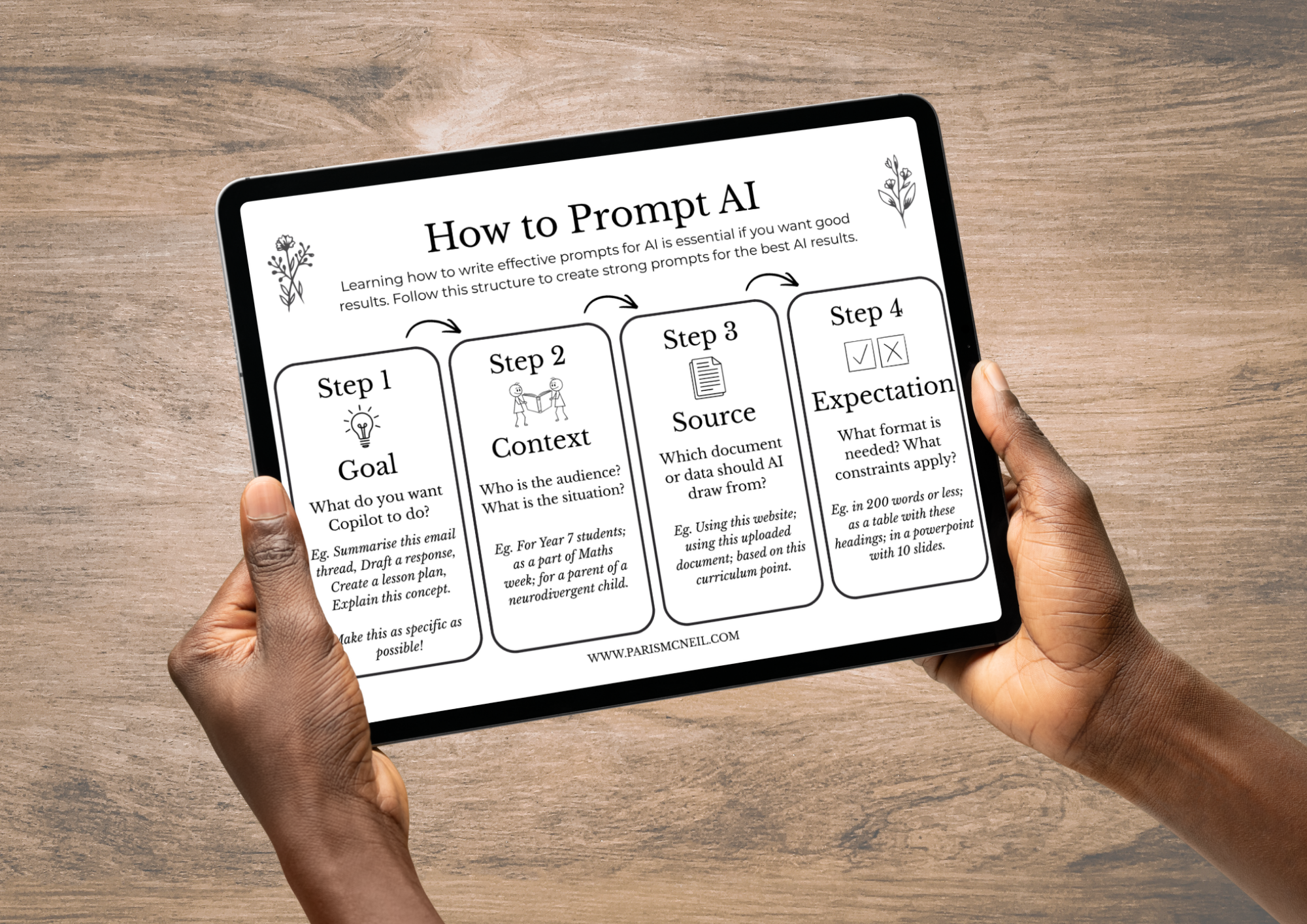
How to Prompt AI Handout
Download this handout to share with your staff for a simple framework to get the best results when prompting your AI.
You should not have to keep up with all of this alone
Teachers are already being asked to teach, assess, support wellbeing and now somehow keep pace with AI and an online environment that can change in weeks. Parents are facing much the same problem at home.
That is what these sessions are designed to help with.
Paris McNeil speaks to thousands of students each year about AI, online safety and emerging technology risks. She has consulted hundreds of Western Australian young people about AI, education, social media and their digital lives.
Her legal background helps her unpack complicated issues around privacy, consent, deepfakes and emerging technology in a way that is clear and practical. As a Gen Z educator, she also understands why young people use these platforms and can translate that world for the adults supporting them.
Paris McNeil is a 2026 Young Australian of the Year nominee, was shortlisted for the 2026 Western Australian of the Year Awards and was a finalist in the 2026 Young Achiever Awards Young Woman Leader category.
The point is not for every teacher or parent to become an expert.
It is to make sure they understand enough to spot what matters, ask better questions and respond well.